


Hexout - Color Hexa Puzzle
Metajoy
Hexout - Color Hexa Puzzle is the kind of small puzzle game I can open without making a commitment. Its central idea is easy to understand: colored hexagon tiles sit on a board, and I tap them so arrows guide them away. That simple interaction gives it an immediately readable identity, but the real appeal comes from how quickly a straightforward move turns into a question of order, space, and patience.
After spending time with it, I see this as a compact brain-training game rather than a dramatic adventure or a long-form strategy experience. It is free, rated for Everyone, and made by Metajoy. The game has already built a strong reception, with a 4.9 average from around 20K ratings and over 100K installs. Those numbers do not replace personal taste, of course, but they fit my impression: this is an accessible puzzle designed to make short sessions feel satisfying.
Why the first few puzzles feel so approachable
My first impression was shaped by the clarity of the board. Hexagonal pieces and directional arrows communicate the basic relationship almost immediately. I did not need a long explanation to understand that a tile cannot simply be removed whenever I want; its route and the pieces around it matter. That is a good starting point for a mobile puzzle because the game asks me to think without first asking me to learn a complicated rulebook.
The tap-to-clear format also suits a phone. I can play with one hand, pause naturally, and return later without needing a large screen or a quiet desk. The controls are direct enough that the challenge comes from reading the arrangement rather than fighting the interface. For a puzzle game, that distinction matters. When I make a mistake, I want to blame my planning, not an awkward gesture.
The opening experience is especially suitable for people who enjoy visual sorting, traffic-flow puzzles, and light spatial reasoning. It is less suitable for anyone looking for a story, character progression, or a competitive match against other players. Hexout stays focused on the board in front of me. That narrow focus is one of its strengths, but it also defines its limits.
Related News






I found the most useful way to approach a new layout was to resist tapping the first tile that looked available. Instead, I scanned the board for pieces whose arrows pointed into open space, then checked whether removing them would expose a better route. This small habit changes the game from random tapping into deliberate planning. It is also the sort of lesson that becomes useful quickly because the board gives immediate visual feedback.
A visual language built around direction
The art direction is not trying to create a detailed world, and that is the right decision for this design. The colored hexagons are the setting, the arrows are the instructions, and the empty spaces are part of the information. By keeping the visual language centered on shape, color, and direction, the game makes the puzzle readable at a glance.
That restraint creates a coherent mood. I do not feel pulled away from the task by a busy background or decorative characters. The board feels more like a clean tabletop than a fictional location, which makes the game comfortable for quick sessions in places where I only have a little attention available. It works well as a quiet waiting-room game or as something to play during a short break.
Gallery
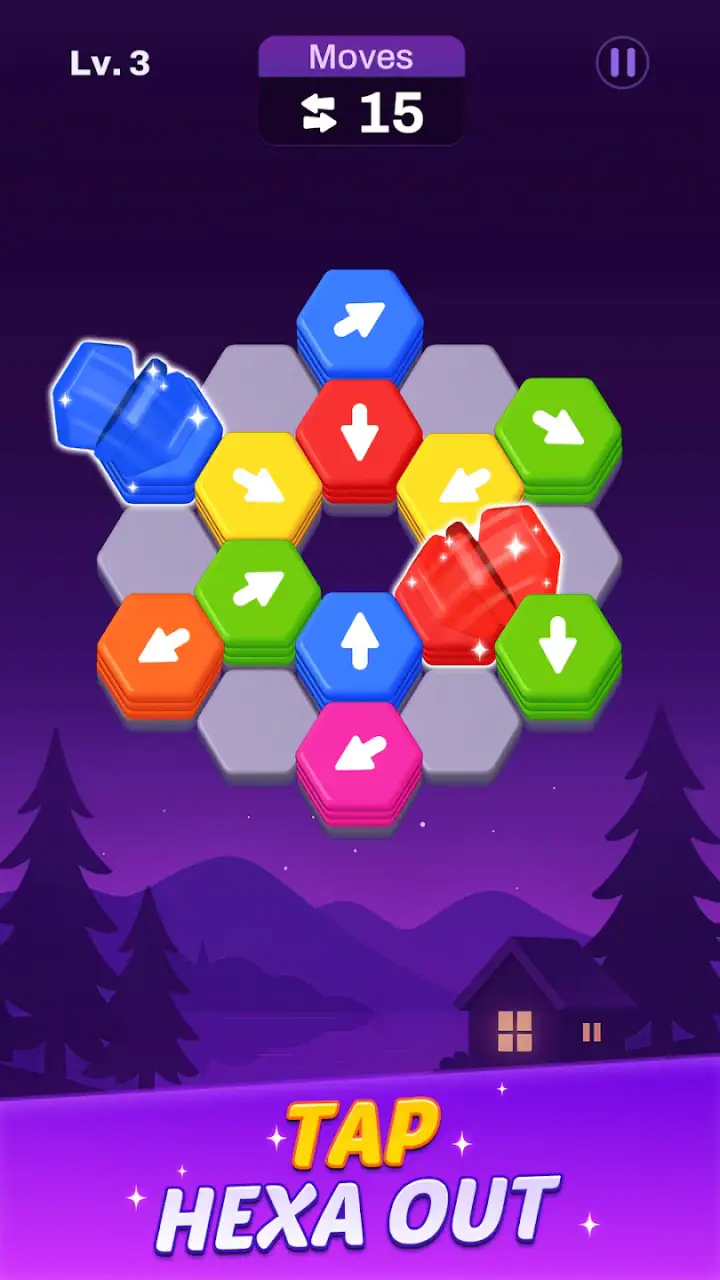
Color is important here, but it is not the only thing carrying meaning. The hexagonal form gives every piece a distinctive silhouette, while the arrows establish movement and intention. That combination is helpful because a puzzle based only on color could become tiring for players who struggle to distinguish similar shades. I still need to pay attention to the palette, but the directional symbols give me another way to read the board.
The trade-off is that this visual simplicity may feel too plain to players who expect constant decoration or a strong sense of place. There is no need to imagine a larger universe around the tiles. The game’s personality comes from order and motion instead. I appreciate that choice, although I would not recommend it to someone choosing a puzzle primarily for character art or narrative atmosphere.
One practical tip is to look at the gaps between pieces as carefully as the pieces themselves. Empty space is not just a background detail; it tells me which arrows may have room to work and which moves could be blocked. When I began treating open lanes as potential resources, I made fewer impulsive taps. This is a subtle but important shift, and it gives the clean presentation more depth than the first glance suggests.
How sound and pacing shape the mood
The game’s mood depends heavily on its rhythm. Each move is small, readable, and connected to a visible result. That creates a calm loop: inspect the board, choose a tile, watch the consequence, then reassess. I enjoy that pace because it gives me time to think without making every decision feel heavy.
Rather than presenting itself as an intense action puzzle, Hexout feels closer to a visual breathing exercise with rules. The board can become mentally demanding, but the interaction remains controlled. That contrast is one of the reasons I can play it when I want stimulation without the pressure of a timer or a fast reflex challenge.
Sound, where present in the play experience, works best when it supports that measured rhythm instead of competing with it. The important audio role in a game like this is confirmation: a tap should feel acknowledged, a successful removal should feel complete, and progress should have a clear sense of closure. I found that the visual feedback remains the main guide, so players who prefer quiet play can still understand what is happening without relying on a dramatic presentation.
The pacing also makes the game appropriate for interrupted use. If I have only a few minutes, I can work through a small part of a layout and stop. If I have longer, I can continue looking for a cleaner sequence. That flexibility is more valuable than it sounds. Many mobile puzzle games are either so quick that they feel disposable or so demanding that opening them becomes a commitment. Hexout sits between those extremes.
There is a limitation to this calm approach. Players who need frequent surprises, escalating spectacle, or a strong soundtrack may find the experience restrained. The atmosphere is coherent precisely because it does not constantly change. For me, that is a benefit during everyday play, but it means the game is better at maintaining concentration than creating excitement.
Where the mechanics reward careful planning
The core mechanic works because every tap has a positional consequence. A tile may look ready to leave, but its arrow can reveal that another piece must be handled first. The board therefore encourages me to read several moves ahead without demanding the complexity of a traditional strategy game. It is a friendly entry point into sequencing puzzles.
I recommend using a three-step mental check before committing to a move. First, I identify the direction of the arrow. Second, I trace the likely path toward open space. Third, I ask what the board will look like after that tile disappears. This method prevents the most common mistake: choosing a move that works immediately but removes the space needed for a more important piece.
A second useful technique is to separate “safe” moves from “necessary” moves. A safe move has a clear path and does not appear to interfere with anything else. A necessary move is the one that unlocks several blocked possibilities. I usually begin with safe moves when I am still learning a layout, but I switch to necessary moves when the board starts to tighten. That distinction helps me avoid wasting attention on pieces that can wait.
The hexagonal arrangement adds a particular flavor to the planning. It does not read exactly like a square grid, so familiar habits from ordinary tile-matching games do not always apply. I need to consider angled relationships and the way neighboring pieces visually cluster. That makes the game feel specific rather than like a reskinned match-three board.
At the same time, the mechanics remain deliberately narrow. There is no need to manage an inventory, build a character, or learn a collection of unrelated systems. If I want a puzzle that rewards pure board reading, this focus is welcome. If I want a broader progression loop with upgrades or a story attached to each stage, I would be better served by another type of mobile game.
The best everyday use case I found was playing during a short commute while waiting for an appointment. I could begin by studying the overall arrangement, make a few deliberate taps, and stop when my attention shifted. The game did not punish me for treating it as a small mental break. That makes it more practical than puzzle titles that require a long uninterrupted session.
Who should play it, and who should skip it
I would recommend Hexout to players who like tidy visual problems, gradual mental pressure, and controls that can be understood almost instantly. It is also a good choice for families because its Everyone age rating matches the uncomplicated presentation. Younger players may enjoy the colors and tapping, while older players can focus on sequencing and spatial awareness.
It is particularly appealing if you enjoy the moment when a crowded board suddenly becomes obvious. The satisfaction does not come from collecting elaborate rewards; it comes from finding the correct order and watching the arrangement open up. That kind of payoff is modest but reliable.
I would skip it if your priority is a narrative campaign, expressive characters, online competition, or a highly varied set of mechanics. I would also be cautious if repetitive visual puzzles lose their charm quickly. The game’s identity is concentrated around colored hexagons and directional clearing, so its success depends on whether that loop itself keeps you interested.
Compared with a typical match-three game, Hexout asks for less pattern matching and more route planning. I am not searching mainly for three identical pieces; I am deciding which object can move without damaging the next decision. Compared with a word puzzle, it offers less language and more visual reasoning. Compared with a physics puzzle, it is more controlled and less experimental. Those differences make it easy to place: this is a deliberate sorting challenge, not a reflex test or a creative sandbox.
Practical details before installing
The game is free to play, which makes it easy to try without treating the download as a major commitment. Its current release is version 0.0.43, and it requires Android 8.0 or later. I would check that operating-system requirement before installing on an older phone, especially if the device is used by a child or kept as a backup handset.
Metajoy presents it as a puzzle game, and that description is accurate without being too broad. The store short description is simply “Hexout,” while the longer presentation points toward tapping and sorting the colored hexagonal tiles. In actual use, the important detail is that the arrows turn each board into a sequence problem. Knowing that beforehand helps set the right expectation: the game is not primarily about decoration, speed, or collecting.
The strong rating and growing install base suggest that the basic idea is connecting with many players, but I would not choose it solely because of that reception. The more useful question is whether you enjoy slow visual deduction. If you do, the free entry point makes experimentation sensible. If you prefer constant novelty, the same focused design may feel limited even if the controls are polished.
The atmosphere holds together because the rules stay visible
What I like most is the agreement between presentation and mechanics. The clean shapes make the arrows easy to follow, the empty spaces support planning, and the steady pace gives each decision room to matter. Nothing about the mood promises a large adventure, so the lack of story does not feel like a missing piece. The game knows that its pleasure comes from making a complicated-looking board understandable.
That coherence also makes the limitations easier to accept. The experience can feel repetitive if I need a dramatic change of scenery, and the restrained presentation will not satisfy players who want a rich audio-visual show. Still, those are not accidental weaknesses; they are the cost of keeping the puzzle readable and calm.
My final recommendation is simple: try Hexout when you want a focused mobile puzzle that rewards looking before tapping. Give it a chance during a short break, and use the board’s open lanes as carefully as the tiles themselves. I would not call it an all-purpose game, but within its narrow space it creates a pleasant rhythm of observation, decision, and release. Its strongest quality is the way art direction, sound, and pacing all stay out of the mechanics’ way while quietly making each successful move feel satisfying.
For me, that makes it an easy recommendation to a friend who enjoys compact brain teasers and wants something approachable rather than overwhelming. It is free, accessible to an Everyone audience, and specific enough in its hexagon-and-arrow design to stand apart from ordinary tile matching. Just know what you are choosing: a calm, focused sorting puzzle, not a story-driven game or a constant stream of surprises. In that role, Hexout delivers a clear and coherent playable mood.
FAQs for Hexout - Color Hexa Puzzle
What is Hexout - Color Hexa Puzzle?
Hexout - Color Hexa Puzzle is a casual puzzle game centered on arranging and matching colored hexagonal pieces. The main objective is to place tiles strategically on the board, create matching color groups or complete required patterns, and clear space for new pieces. Its simple rules make it easy to begin, while limited board space and increasingly challenging layouts require careful planning.
How do you play Hexout - Color Hexa Puzzle?
Gameplay is based on selecting and positioning hexagonal color pieces on the available board. Depending on the level or mode, you may need to connect matching colors, complete shapes, or remove groups without blocking future moves. The most effective approach is to think several moves ahead, preserve open spaces, and avoid placing tiles randomly when the board begins to fill.
Is Hexout - Color Hexa Puzzle free to download and play?
Hexout - Color Hexa Puzzle can generally be downloaded and played without an upfront purchase, although the exact availability of free content may depend on the Android or iOS version. Like many mobile puzzle games, it may include advertisements, optional purchases, or additional features connected to progression. Check the store listing before installing for current pricing and in-app purchase details.
Does Hexout - Color Hexa Puzzle require an internet connection?
The core puzzle experience may be suitable for short offline sessions, which is convenient when traveling or when mobile data is unavailable. However, certain functions can require an internet connection, including advertisements, store transactions, updates, online events, synchronization, or other connected services. If offline play is important to you, test the game after installation and review its current permissions and store information.
Who will enjoy Hexout - Color Hexa Puzzle, and is it difficult?
This game is a good choice for players who enjoy relaxed color-matching puzzles, spatial challenges, and short sessions that do not require complicated controls. The opening stages are usually approachable for beginners, but later boards can become considerably more demanding as space becomes limited and mistakes are harder to recover from. It is best suited to casual players who enjoy gradual progression and strategic thinking.
Pros
- Simple hexagonal board makes the rules easy to understand.
- Short rounds are ideal for quick breaks or casual play.
- Color-matching mechanics offer satisfying visual feedback.
- Gradually harder puzzles can help maintain interest over time.
- Works well for players who enjoy calm
- low-pressure challenges.
Cons
- Some levels may feel repetitive after extended play sessions.
- Limited gameplay variety can reduce long-term replay value.
- Color-focused puzzles may be difficult for players with color blindness.
- Progress can feel slow if later stages require repeated attempts.
- Small hexagonal pieces may be tricky to distinguish on smaller screens.


